One delivered briefing, with the working shown.
This is a real Heritage briefing for a real person, reproduced with permission: Rylan Ray McNeely, born 11 October 1993 at 09:26 CDT in Oklahoma City. Thirteen names across four generations, 112 cited sources. Below, each section as the recipient sees it, with a note on what it is, where the evidence came from, and where interpretation begins.
The live briefing opens in a new tab. Every screenshot below is taken from it unretouched; nothing here is a mockup.
The walkthrough
Eight sections in the order they are delivered. The two labels that matter are documented — a record exists and is linked — and tradition, which means a symbolic system is being reported, not a fact.
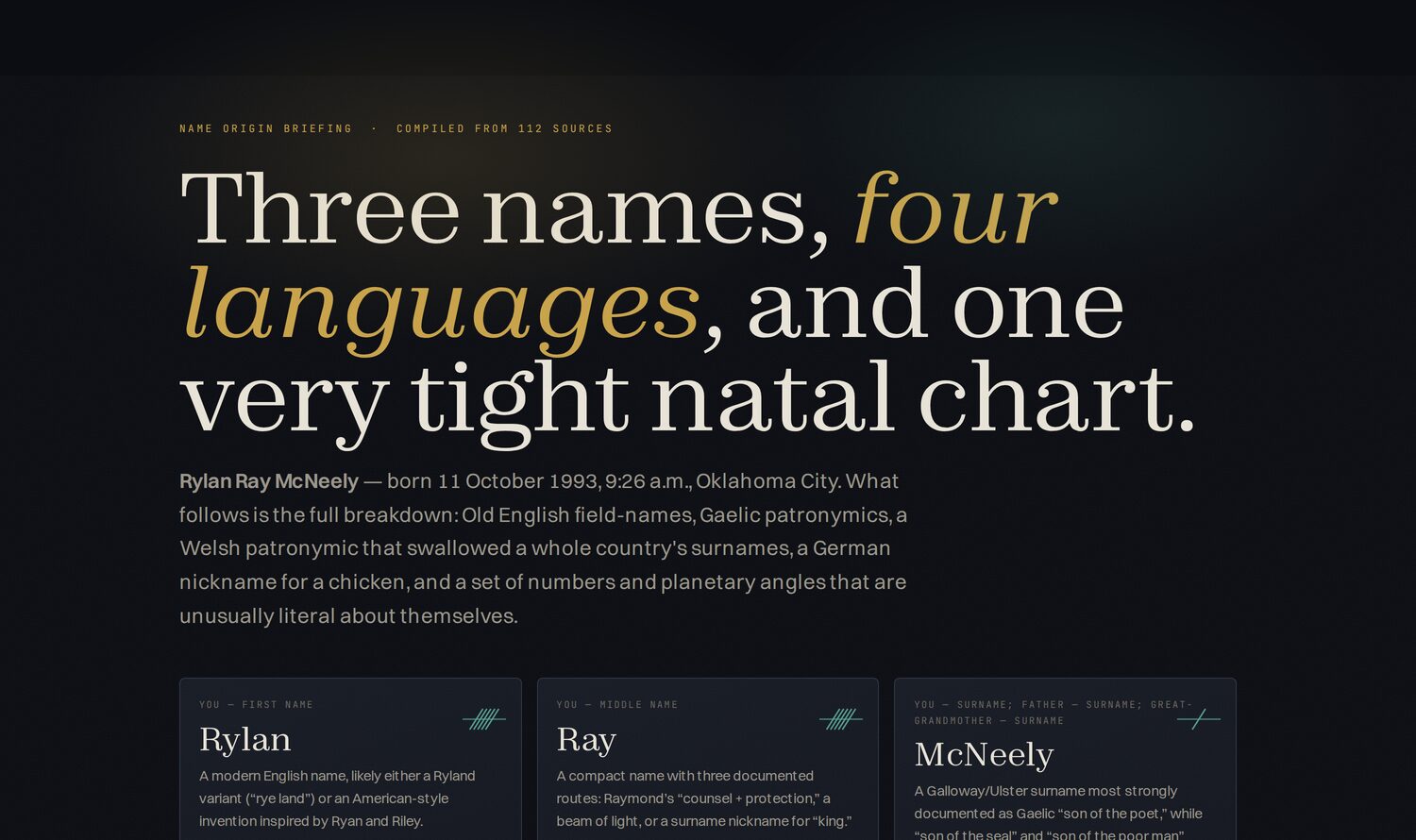
The name, the minute, the index
The briefing opens on the data it was built from, so an error is visible immediately rather than three sections deep. Birth data is shown in local civil time with the UTC offset and the Julian Day alongside — 2449272.1014 — because that number is what the ephemeris actually consumed.
- Everything is addressableEach section has a permanent anchor, so a specific finding can be sent to a relative as a link.
- One page, no loginThe briefing is a private URL. There is no account, and nothing expires.
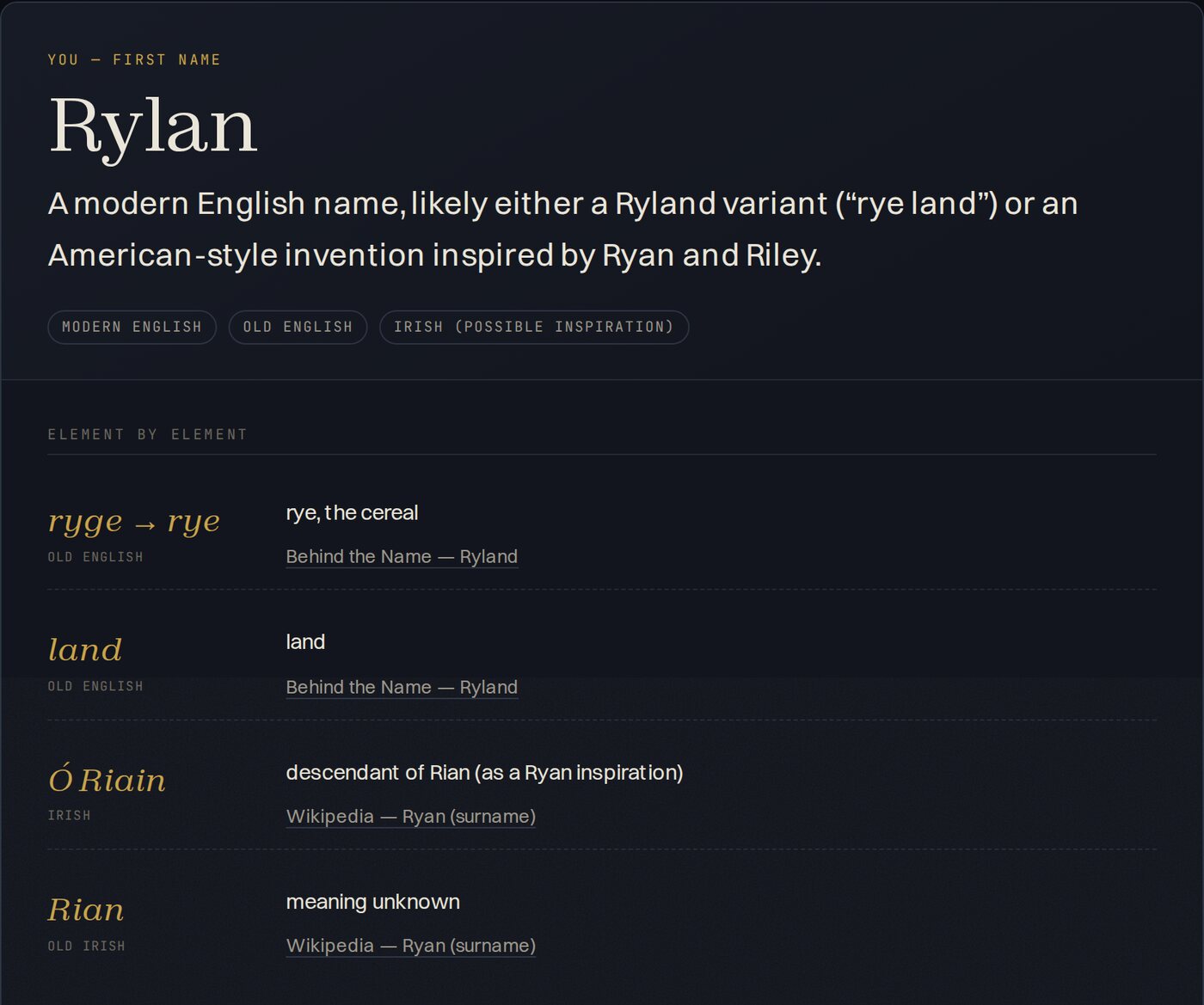
Every name, broken to the morpheme
McNeely resolves to Gaelic mac — “son of” — plus an fhilidh, the genitive of filidh, a professional poet in the Gaelic learned orders. Son of the poet. The section also prints the two competing derivations rather than choosing the flattering one: Mac Conghaile, son of the seal-hound, and an fhailghigh, the poor man.
- DocumentedEach morpheme carries a link to a dictionary or onomastic source. Hinkle traces to Middle High German hünkel and Old High German huoninklīn, a diminutive of huon, fowl.
- Etymology is not descentThat a name means “son of the poet” tells you about the word. It is not evidence that any ancestor was a poet, and the section says so in place.
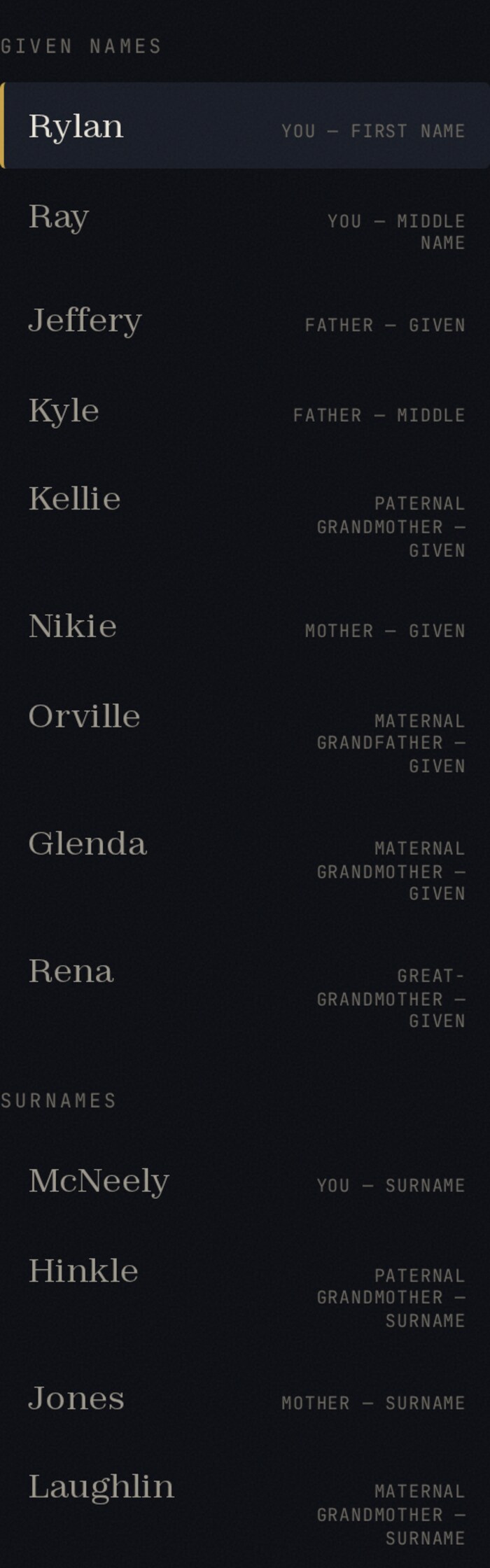
Thirteen names, four languages
A Heritage brief does not stop at the surname. Jones runs back through Welsh ap Siôn to Latin Iohannes, Greek Iōannēs and Hebrew yo + ḥanan. Laughlin is Ó Lochlainn, descendant of a man named for Norway, from the same root as Lochlannach — Viking. Kellie is Ó Ceallaigh, from ceall, church.
- Given names get the same treatmentRylan is handled honestly: either the surname Ryland, Old English ryge + land, rye land, or a late-twentieth-century coinage. The popular “little king” reading is rejected, with the reason.
- Distribution dataPeak United States rank for Rylan was 146 in 2011, 370 in 2024. Names carry dates as well as meanings.
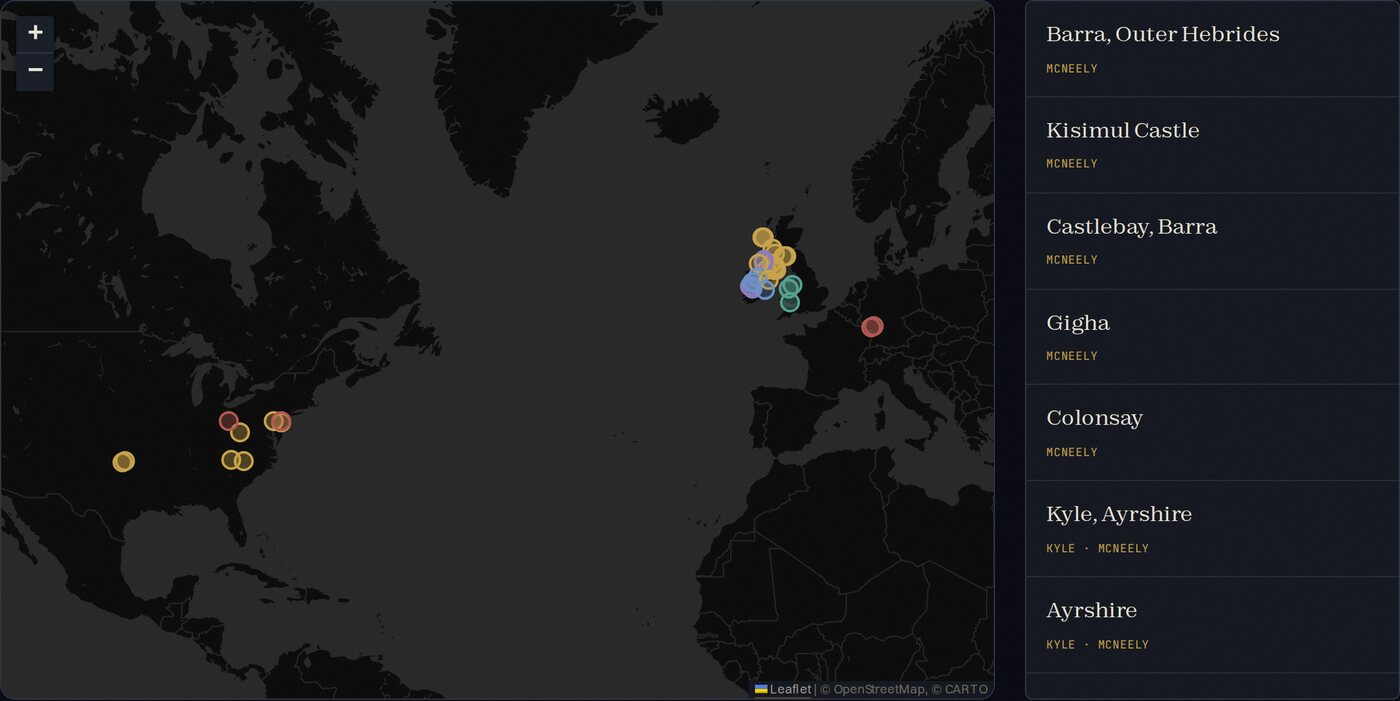
Where those words were spoken
The map is filterable by surname line and every pin is cited. Barra and Kisimul Castle for one Hebridean thread; Gigha, Colonsay and Kyle in Ayrshire for the Galloway crossing; Antrim, Down, Belfast, Carrickfergus, Downpatrick and Inishowen for the Ulster stretch. It is a map of where the names are attested, not a claim about who lived there.
- Heritage tier onlyThe Chart tier has no map, because a map with uncited pins is decoration.
- No connection is impliedA pin means the name is documented in that place. It does not mean your family is from there, and the caption on every pin says which of the two it is.
Records, graded by how much they prove
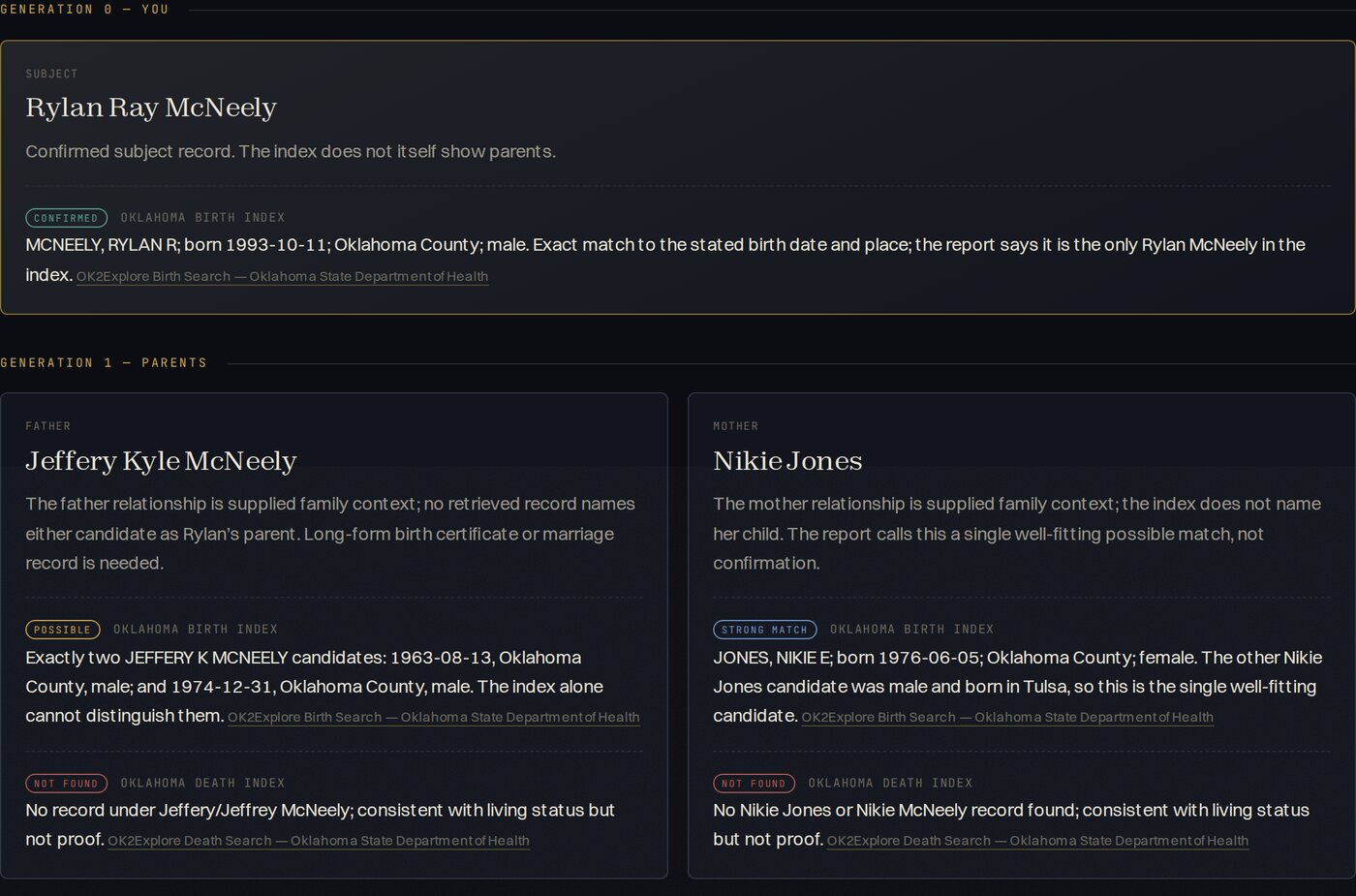
Every person in the lineage carries a grade — confirmed, strong, possible, not found — and the record that earned it. The earliest confirmed McNeely burial in this line is Jane McNeely, 1822 to 1908, in Checotah Cemetery, McIntosh County, in what was then Indian Territory. William Henry McNeely Sr., 1869 to 1946, is one of 38 McNeely interments indexed in Oklahoma County, out of 251 in the state.
- DocumentedSources are state vital indexes, census enumerations, marriage licences and burial records, each linked to the holding institution rather than reproduced.
- Clustering as methodSurname clusters in a single cemetery — the McNeely group in Tillman Cemetery — are treated as a lead to test, not as a proven family group.
How the lines converged on one county
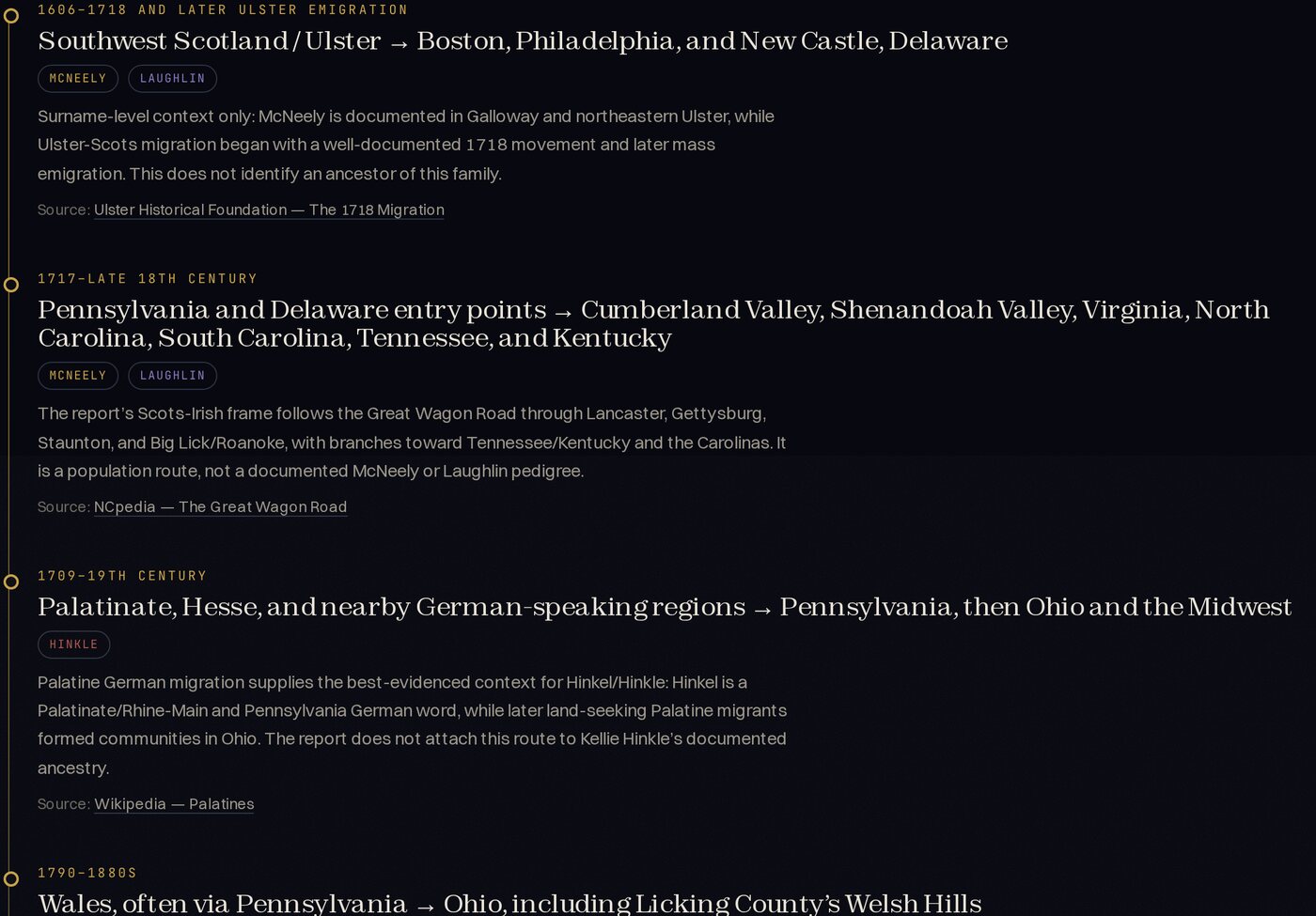
Six dated eras, each tagged to the lines it applies to: the Ulster plantation from 1606, the Scots-Irish crossings from 1717, Palatine German emigration from 1709, the long nineteenth-century movements from 1790 and 1820, and the Oklahoma land runs before statehood in 1907. The timeline ends in October 1993 with a birth in Oklahoma City, which is the point of the section.
- Eras, not itinerariesWhere no passenger record survives, the briefing places the line in an era and says that is what it is doing.
Both systems, and the arithmetic shown
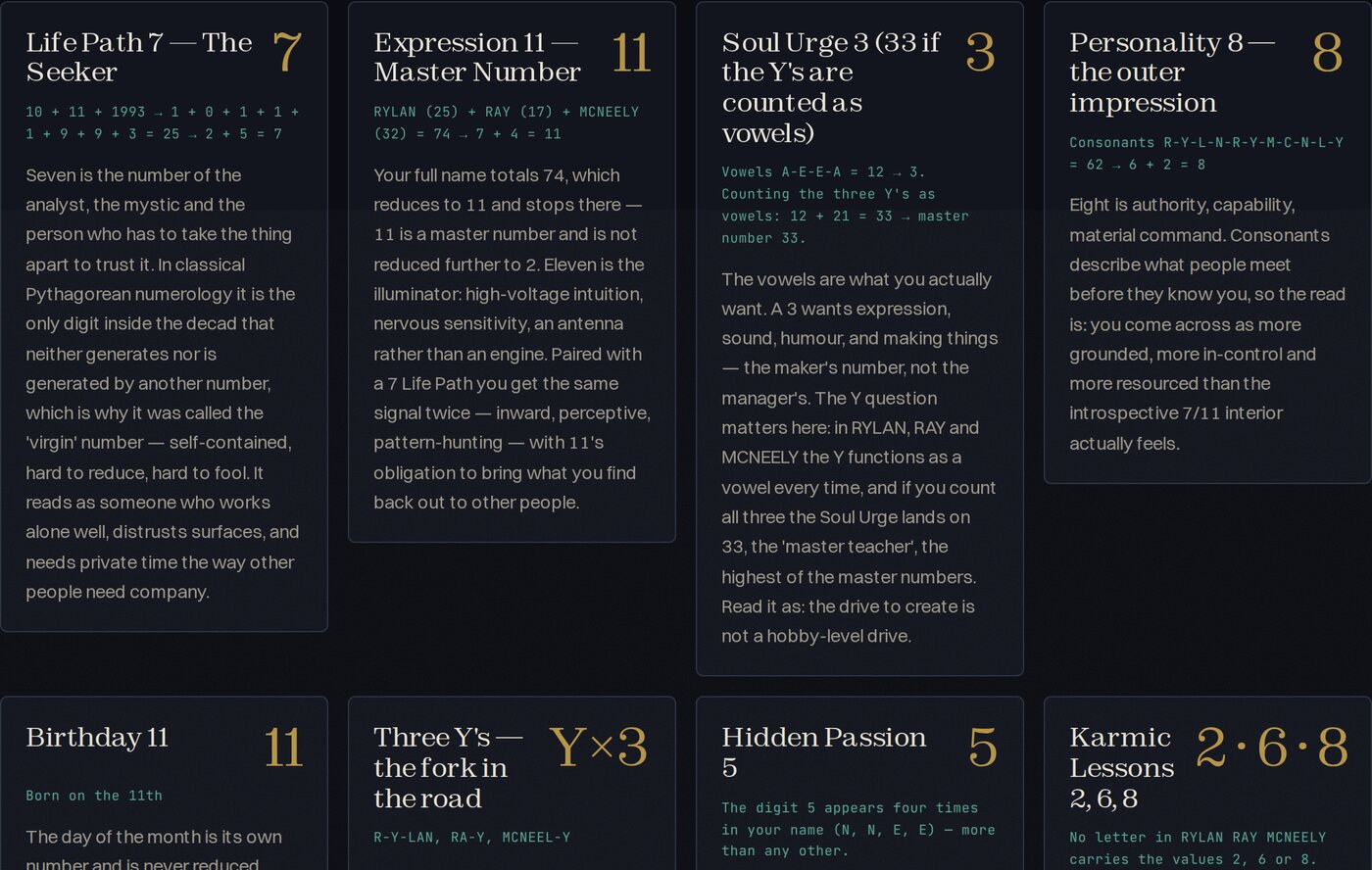
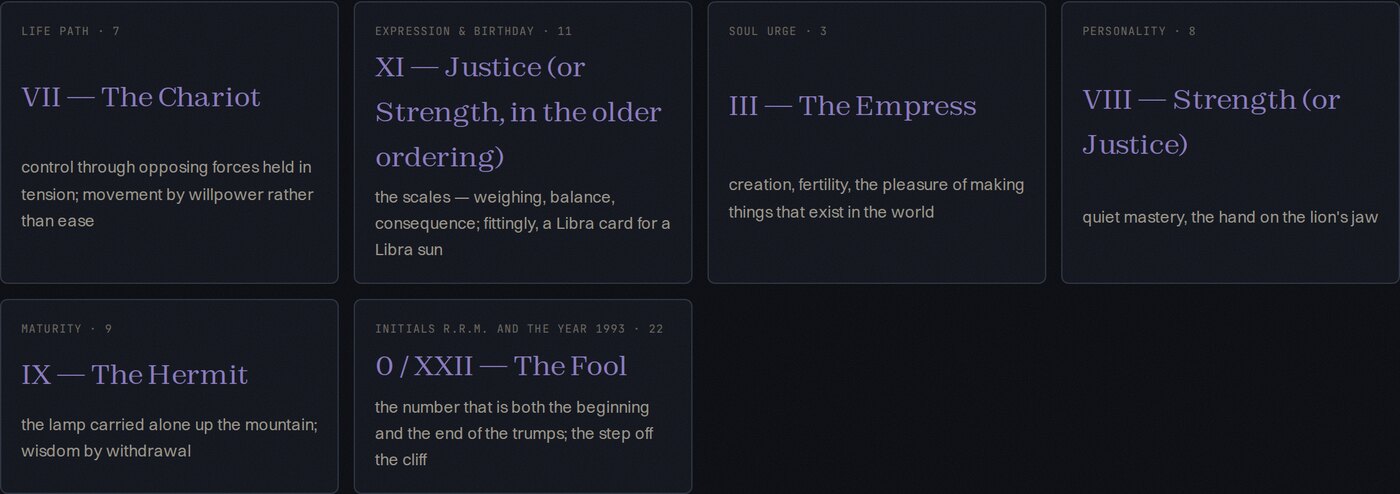
Expression 74, held at 11. Soul Urge 12 reducing to 3. Personality 62 reducing to 8. The Chaldean cross-check totals 42 and reduces to 6, and the section states plainly that the two systems disagree and that nothing decides between them. Life Path 7 from the birth date. Three Y’s in the name, and a note on how the Y rule changes two of those numbers.
- Tradition, not evidenceNumerology is reported as a documented symbolic system with its sources named. It is not a claim about character and is not advice.
- Free elsewhereThis section is the free Name Reading, in full, at no charge — run it on any name.
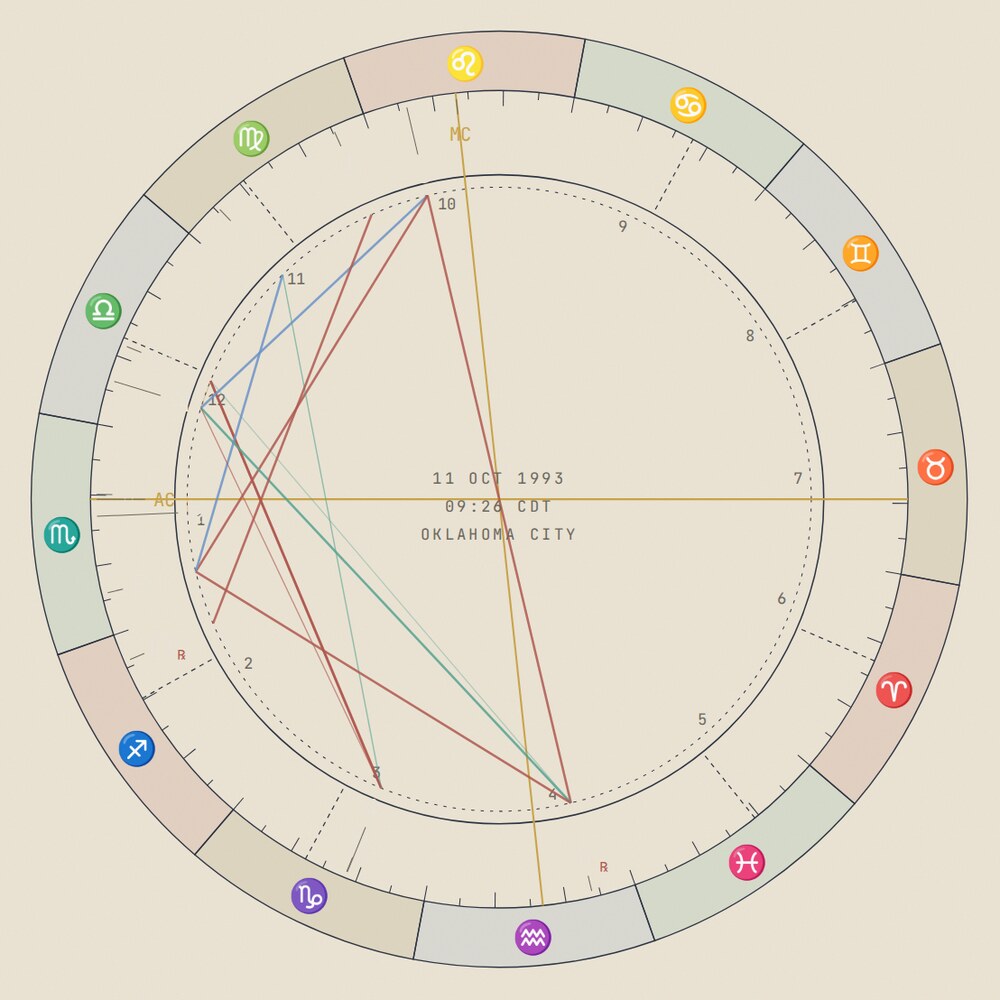
A real ephemeris, drawn by hand
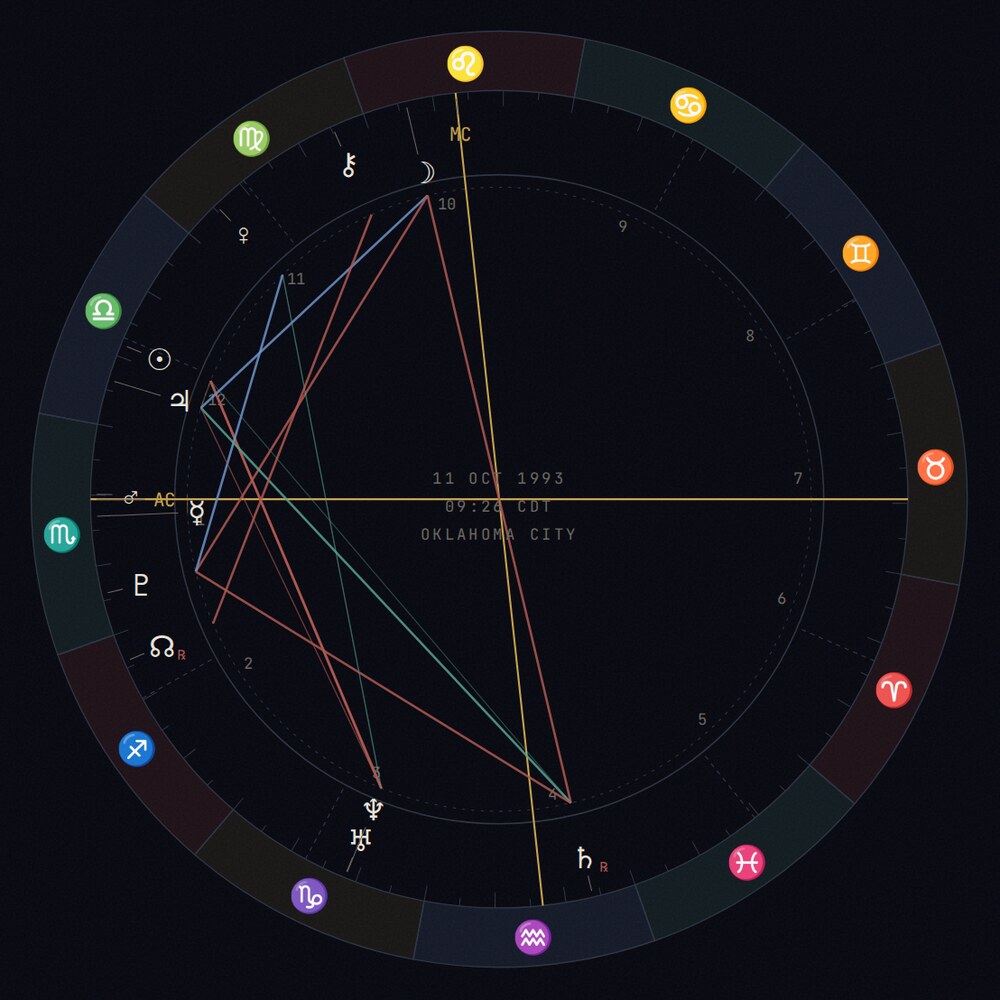
Positions come from the Swiss Ephemeris, houses are Placidus, and the wheel is drawn as line work rather than exported from chart software. Sun 18°17′ Libra in the twelfth. Moon 23°52′ Leo in the tenth. Mercury 13° Scorpio in the first. Saturn 23°52′ Aquarius in the fourth, retrograde.
- Orbs are printedSun square Uranus at an orb of 0.03°, Sun square Neptune at 0.13°. Aspect tables give the exact separation, because that is the part that is checkable.
- Both themesThe figure redraws for the parchment theme rather than being inverted.
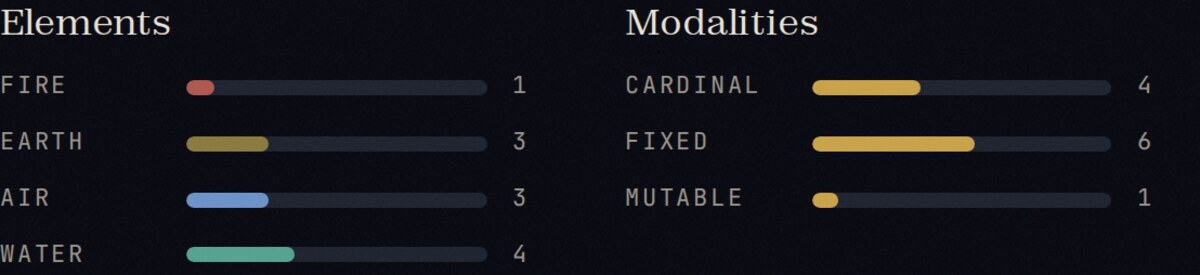
The table under the picture
The wheel is the illustration; the table is the data. Each aspect is listed with both bodies, the angle, the exact orb and whether it is applying or separating. Hovering any line in the wheel highlights its row.
- Computed, not interpretedThe table contains no interpretation at all. Interpretation is kept in a separate, labelled block.
The tree alphabet
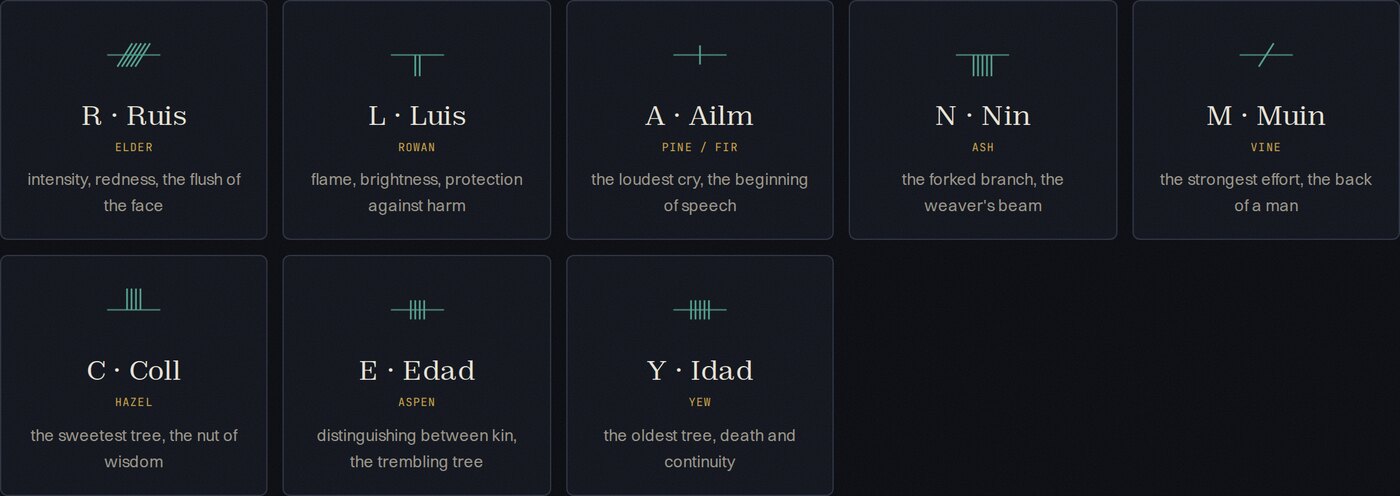
The name is cut along a stem in Ogham, then each letter is given its tree and its kenning from the glossaries: Nuin, ash, “checking of peace”; Ruis, elder, “intensest of blushes”. Letters that did not exist in primitive Irish are shown as substitutions and labelled as such.
- TraditionThe tree associations come from medieval glossaries, not from the inscriptions themselves. The section says which is which.
The trumps, and where they come from
Letter-to-trump correspondences are given with the attribution system they belong to, because there is more than one and they contradict each other. That contradiction is printed rather than resolved.
- TraditionReported as a symbolic system with its lineage named. Not a prediction, not advice.
- OmittableFor a memorial or a formal gift, the esoteric sections can be left out entirely on request, leaving only the documented record.
What could not be found, printed
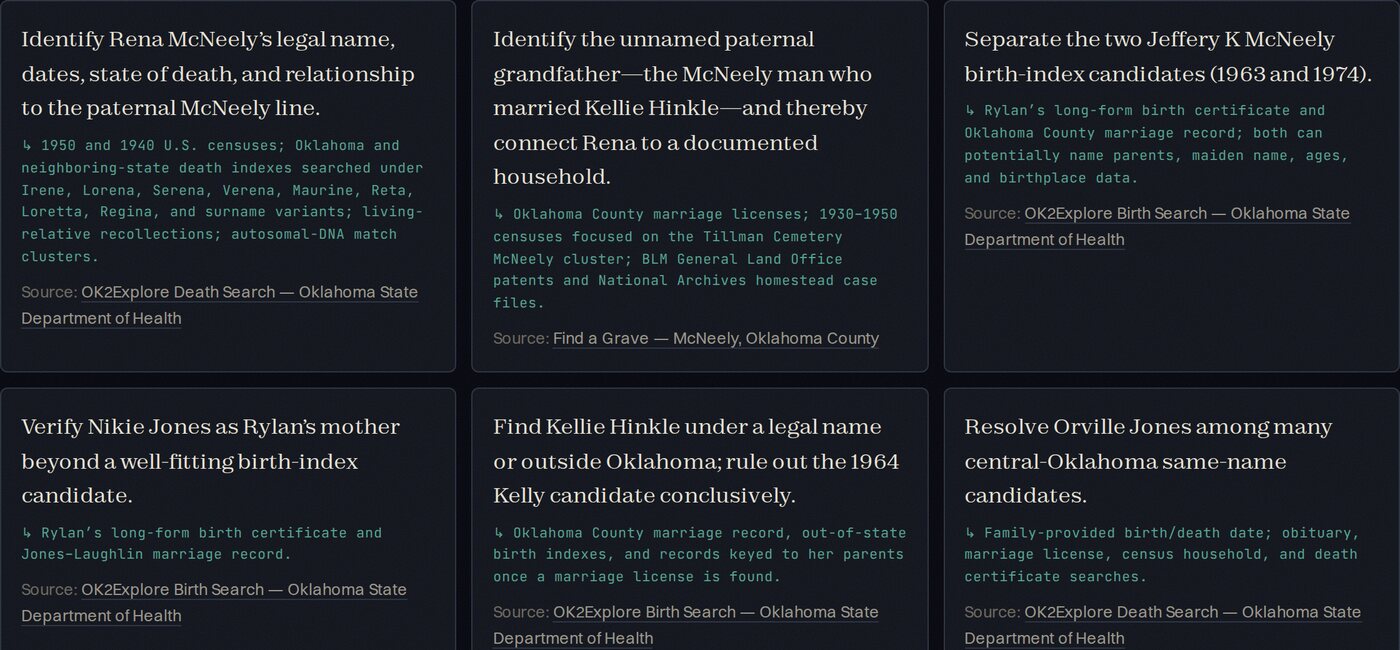
The section nobody else ships. In this briefing, Rena McNeely could not be located under Irene, Lorena, Serena, Verena, Maurine, Reta, Loretta or Regina. Rather than round that up, the briefing lists what to pull next: the 1950 and 1940 federal censuses, the Oklahoma death index at OK2Explore, Oklahoma County marriage licences, General Land Office patents, NARA homestead files, and autosomal DNA match clustering.
- A deliverable, not an apologyNamed gaps are what makes the confirmed findings worth anything. A briefing may honestly conclude that a line goes cold, and say so in those words.
- 112 sourcesEvery one linked, with the holding institution named. Nothing is asserted without one.
The parchment theme is not an inversion
The briefing ships in ink-on-dark and ink-on-parchment. The chart figure is redrawn for each rather than filtered, because a wheel that has been colour-inverted looks like a mistake. Use the toggle in the header on this page to see the same treatment applied to the marketing site.
- Both themes are print-safe; the PDF uses the parchment palette
- Theme is a viewing preference and changes nothing in the content
Yours will be shaped by what the records give up.
This briefing ran to 112 sources because the names were traceable and the county kept good indexes. Some families give more, some give a documented dead end. Either way you get the working, graded, with the gaps named.